
Long ago the forest was singing, and the songs had a shape. Landscapes are built from fields that organise themselves, like tree rings they build upon each other. Nature gets away with things that should not work. What works, works, nothing breaks the rules. Life happens at the limits. Breathing in, breathing out.
A lot of the job is just noticing. Somewhere along the way most of us stop really seeing things, and working outside every day keeps undoing that for me. Gardening trains you to look at what everyone else walks past: a split in some bark, lichen creeping over a stone, frost sitting on a leaf, a seedhead catching the low sun. I keep that switched on in the studio and follow whatever catches my eye, even when I can't explain why.
The same net shows up everywhere once you start looking for it. It's fascinating to me. I'm sure you have seen oil in water? Or zebra stripes and leopard spots? These are thought to arise from reaction-diffusion systems, the kind Alan Turing described, where two chemicals spread at different rates and settle into repeating patterns. Weirdly, it's not just seen in living things. On the Australian coast it is called honeycomb weathering, stone lace, or miniature tafoni. The process is still debated by geologists, which is part of why it feels so mysterious. Crown shyness in the canopy is another version – branches that refuse to touch, leaving gaps that look like a net of light. Evolution arriving at a solution that works.
A crack is the one thing a painter is trained to avoid, but I love it. The crack is the physics showing its hand, the moment the material tells you what it actually is instead of what you asked it to be. I want that kind of honesty in a surface, the kind that comes from letting the process run rather than forcing it into a shape.
I've learned to leave the mistakes in. When a surface cracks somewhere I didn't plan, my first instinct is to fix it, but nine times out of ten that's where the life is. I'd rather a painting feels right than looks perfect. I'm working with the materials as much as I'm in charge of them, and they have opinions.
Below the scale of the hand, cells gathering, channels opening between them. It lives briefly on the surface and a battle is fought. Curious and spellbound, I watch an amalgamation of forces crystallise, waves and ripples from within. The structure holds. It dries and flattens to the canvas.
I don't really think my way through a painting. It's more like listening, and following what feels right, which is harder than it sounds. It still feels mysterious to me. Alive, somehow.
I love the edge where beauty turns a bit unnerving, like fog rolling into a wood at dusk, or a river running fast and dark after rain. I want the paintings to have a little of that pull.
If a painting feels safe, I've usually played it too carefully. The ones I love most are the ones where I pushed further than was comfortable.
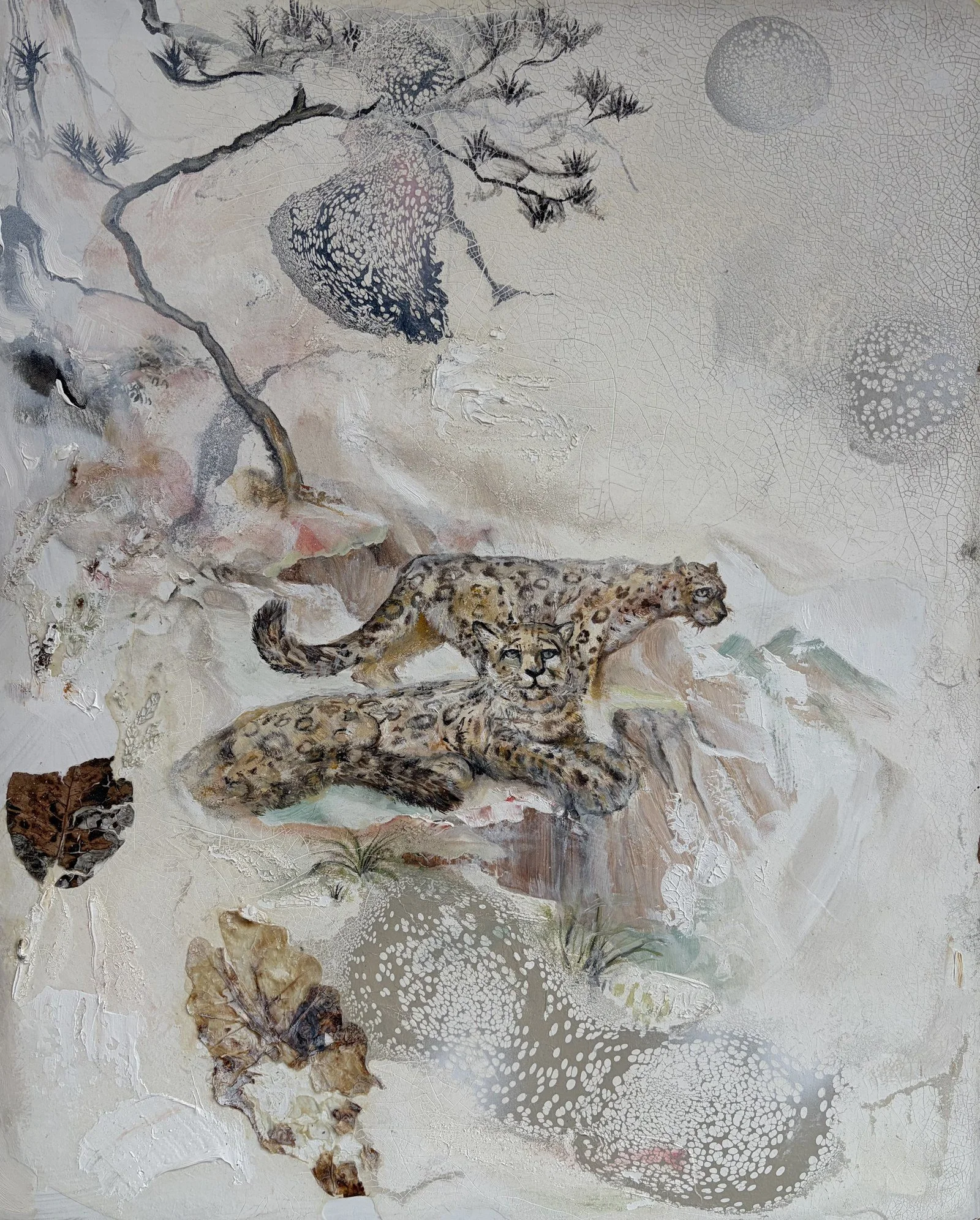
Sense that there's something much bigger at play. I want the painting to hold both: the unease, and the beauty of the fragile scaffolding of life. The pattern is not a texture laid on top of a picture. It is a field that has already decided how to occupy space, dark cells packed so that what remains between them is a pale, continuous net. In the paintings that net settles into forest and light.
Most of my ideas turn up while I'm working. I'm a gardener as well as a painter, so I spend a lot of time outside, pruning, clearing, planting. Every so often something stops me: sun catching a bit of moss, shadows moving across a lawn, the colour of a pond late in the day. I take a photo or just try to remember it, and that's usually where a painting begins.
Back in the studio I don't start with a picture. I start with a surface. I mix different techniques and let the layers build up, split and settle until the panel has its own texture and character. It's a bit like preparing soil before you plant anything.
Then I go looking for the landscape in it. Sometimes a crack becomes a branch, or a rough patch turns into water. I work with whatever turns up, building up light and depth until it starts to feel like you could walk in.
I suppose that's how I think about my paintings. They're not copies of a place, more the feeling of being somewhere green and quiet, made out of a surface that grew a bit like a garden does.
Nothing is repeated and everything rhymes.